Snow Crash
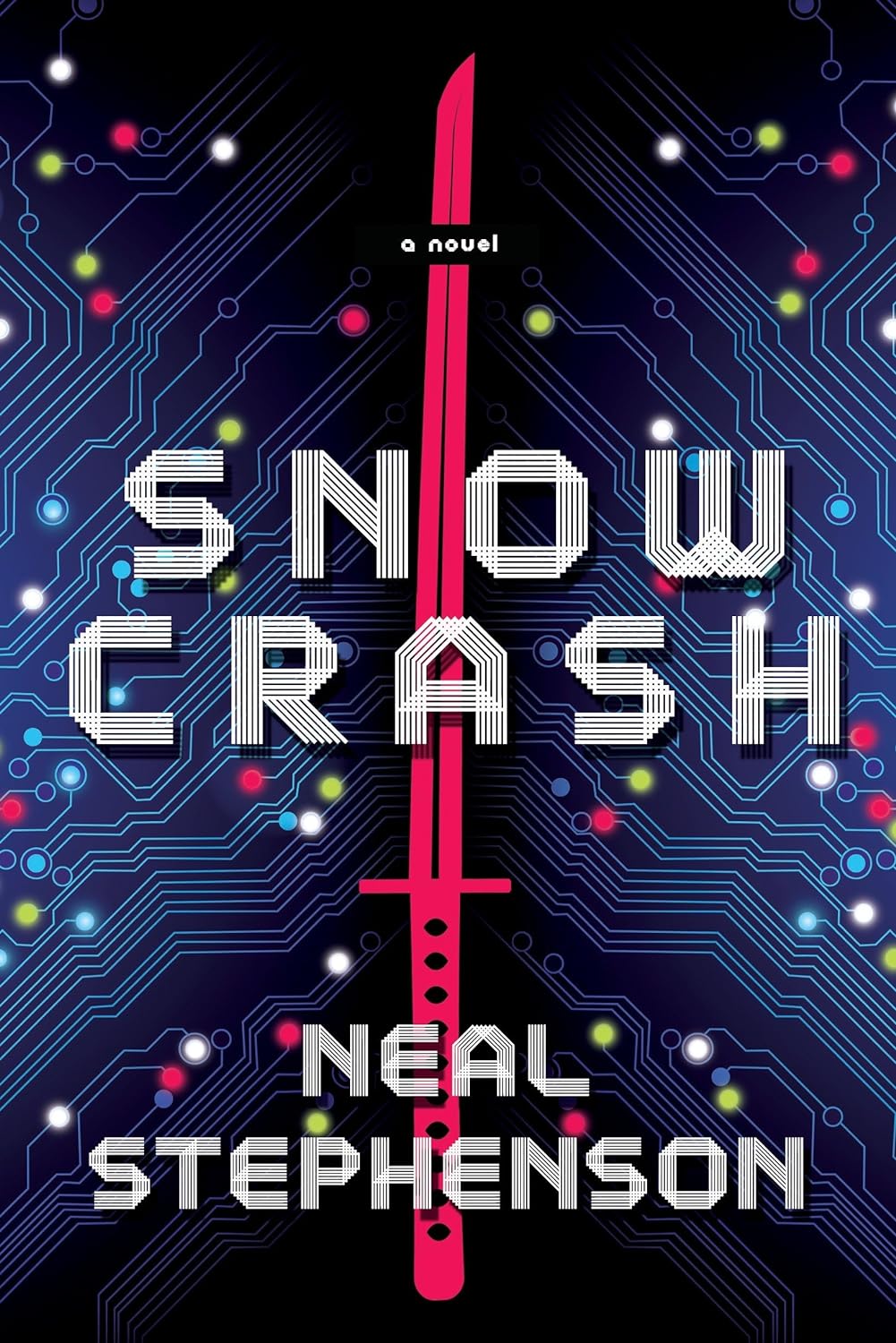
A “post-cyberpunk” classic that coined the term “Metaverse” decades before Facebook rebranded itself. Neal Stephenson’s vision features Hiro Protagonist (yes, that’s his name), a hacker and pizza delivery driver for the Mafia in a future where the U.S. government has collapsed and corporations rule everything. The novel’s opening sentence—”The Deliverator used to make software. Now he makes deliveries.”—perfectly captures its themes of technological obsolescence and economic precarity. When Hiro discovers a mysterious new drug/computer virus called Snow Crash that affects both the digital and physical worlds, he’s drawn into a conspiracy involving ancient Sumerian mythology, linguistic viruses, and a private security force called Mr. Lee’s Greater Hong Kong.
Stephenson’s world-building is simultaneously absurd and terrifyingly plausible. The United States has fractured into corporate enclaves, residential bubbles, and franchise-organized quasi-national entities (FOQNEs). Citizens carry nuclear weapons for self-defense, and the only functioning infrastructure is what corporations find profitable to maintain. Yet within this chaos, Stephenson finds dark humor and genuine humanity. Hiro’s relationship with YT, a teenage skateboard courier with a heart of gold, provides emotional grounding amid the chaos. Their adventures through the Metaverse—a virtual reality space where people interact through avatars—feel remarkably contemporary, anticipating everything from online identity to digital economies.
What elevates “Snow Crash” beyond its cyberpunk trappings is its intellectual ambition. Stephenson weaves together linguistics, anthropology, computer science, and religious studies into a coherent (if wildly speculative) theory about how language shapes reality. The novel’s central conceit—that ancient Sumerian is a neurological “ur-language” that can hack the human brain—may be pseudoscientific, but it serves as a powerful metaphor for how information technologies rewire our consciousness. The book’s critique of corporate power, media saturation, and the commodification of everything from religion to national identity remains devastatingly relevant. More than thirty years after its publication, “Snow Crash” continues to influence how we think about virtual worlds, digital identity, and the intersection of technology and culture.