Neuromancer
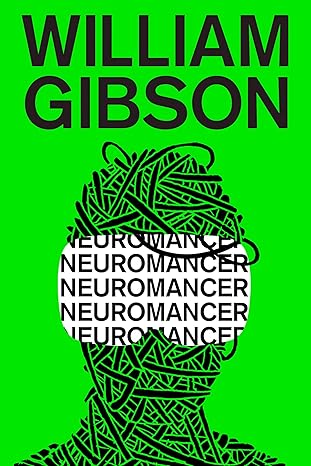
Published in 1984 (interestingly enough), this is the book that invented the “hacker” aesthetic we see in movies like The Matrix. William Gibson’s groundbreaking cyberpunk novel introduced the concept of “cyberspace” and established the genre’s defining tropes: gritty urban decay, corporate dominance, body modification, and the fusion of human consciousness with digital networks. Case, a washed-up console cowboy whose nervous system was damaged as punishment for stealing from his employer, gets a second chance when a mysterious employer offers to repair his body in exchange for one last job. Teaming up with Molly Millions, a street samurai with retractable claws and mirrored eyes, Case navigates a world where the line between reality and virtual reality has all but disappeared.
Gibson’s prose is dense, poetic, and deliberately disorienting. He throws readers into a fully realized future without exposition, forcing us to piece together the rules of this world through context and implication. The novel’s famous opening line—”The sky above the port was the color of television, tuned to a dead channel”—establishes its bleak, media-saturated atmosphere. Gibson’s descriptions of cyberspace as a “consensual hallucination” of geometric shapes and data structures created the visual language for how we imagine virtual worlds. The novel’s influence extends far beyond literature; it shaped everything from video game design to fashion to how tech companies market virtual reality.
What makes “Neuromancer” more than just a style exercise is its exploration of identity in a post-human world. Case’s journey is ultimately about what it means to be human when consciousness can be digitized, bodies can be modified, and memories can be erased or implanted. The novel’s ambiguous ending, with the AI Wintermute achieving its goal of merging with its counterpart Neuromancer, raises profound questions about the nature of intelligence, consciousness, and what happens when artificial minds surpass their creators. Despite being written before the World Wide Web existed, Gibson’s vision of a global network where information is the ultimate currency feels eerily prescient. “Neuromancer” remains essential reading not just for its historical importance, but for its enduring insights into technology’s impact on human identity and society.