Cryptonomicon
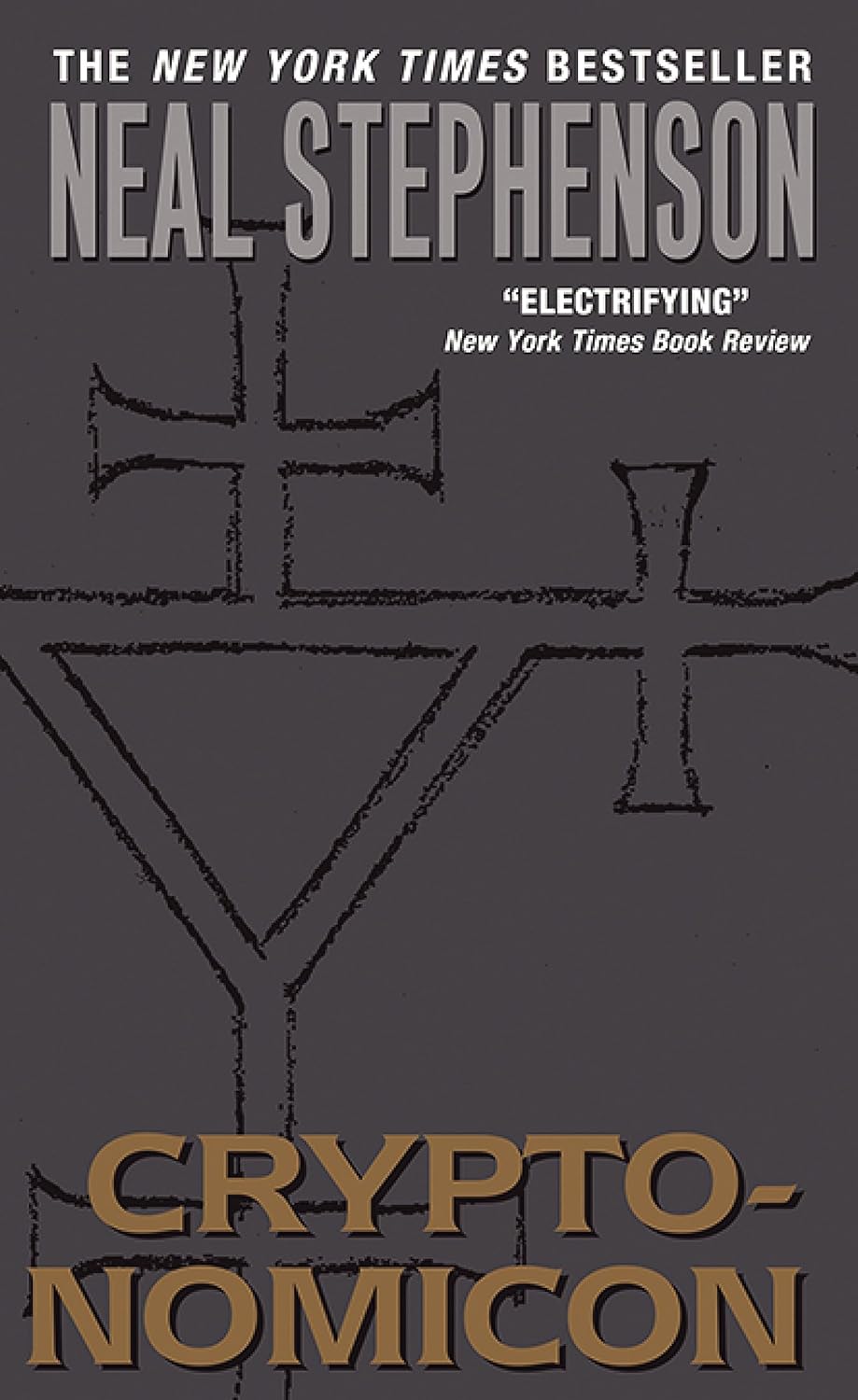
This is the ultimate “nerd epic.” Neal Stephenson weaves two parallel narratives: World War II codebreakers (including a fictionalized Alan Turing) working to crack Japanese and German ciphers, and 1990s tech entrepreneurs attempting to create a “data haven” in Southeast Asia to escape government control and preserve digital freedom. The novel spans generations, connecting the birth of modern cryptography with its digital evolution, all while exploring themes of information theory, libertarianism, and the eternal struggle between privacy and power. At nearly 1,000 pages, it’s dense, ambitious, and unapologetically technical—but also witty, adventurous, and surprisingly accessible.
Stephenson’s genius lies in making complex mathematical concepts dramatically compelling. The WWII sections follow Lawrence Waterhouse, a mathematical genius working with Turing at Bletchley Park, as they develop the theoretical foundations of modern computing and cryptography. These chapters are meticulously researched, capturing both the intellectual excitement of codebreaking and the brutal realities of war. The contemporary storyline follows Lawrence’s grandson Randy Waterhouse, a Silicon Valley programmer who teams up with a motley crew of entrepreneurs, libertarians, and former military personnel to build a secure digital infrastructure on a fictional island nation. Their goal: create a jurisdiction-free zone where information can flow without government interference—a direct response to the surveillance concerns that would later make Snowden famous.
What makes “Cryptonomicon” so influential is its prescient vision of the digital future. Stephenson anticipated cryptocurrency (describing a digital gold-based currency years before Bitcoin), cloud computing, data sovereignty issues, and the tension between technological innovation and regulatory control. The novel’s exploration of how information becomes power—and how power seeks to control information—resonates deeply in our current era of data breaches, encryption debates, and digital authoritarianism. Stephenson doesn’t shy away from the moral ambiguities of his characters’ quest; the data haven project raises legitimate questions about accountability, criminal exploitation, and whether technological solutions can truly escape human nature. The book’s blend of historical accuracy, technical detail, and philosophical depth has made it required reading for generations of cryptographers, programmers, and privacy advocates. It’s not just a novel about cryptography—it’s a foundational text for understanding why cryptography matters in the first place.